

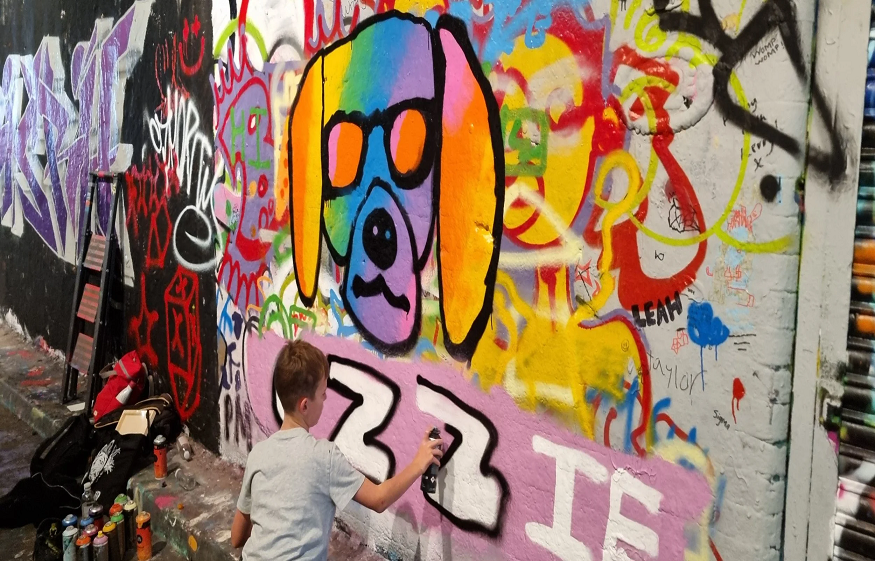
A group activity does not have to be competitive to be engaging. Some of the most memorable experiences happen when people are given a shared task but enough freedom to approach it in their own way. Graffiti is a particularly interesting example because it combines visual creativity, practical skills, personal expression and collaboration in one activity.
A graffiti workshop can look simple from the outside: participants receive spray cans, learn a few techniques and create a piece of artwork. In practice, however, the process involves much more. Participants have to make visual decisions, experiment with unfamiliar materials, respond to other people’s ideas and turn an empty surface into something recognisable.
This combination helps explain why graffiti has become a popular format for corporate activities, school programmes, cultural events, family experiences and other group occasions.
Graffiti starts with participation rather than observation
Many creative activities are primarily observational. People visit an exhibition, watch an artist work or look at a finished mural. A graffiti workshop changes that relationship by making the participant part of the process.
Read More : Stylish Kurti Designs For Girls, Men’s Silver Rings Jewelry & Elegant Marriage Reception Sarees
Instead of viewing a completed artwork, the group begins with a blank surface.
That changes the psychology of the activity. There is no finished image to imitate and no single correct result. Participants have to make decisions themselves. Even a simple letter can be changed in shape, proportion, colour or composition.
This makes graffiti a particularly accessible form of contemporary art. Previous artistic experience can be useful, but it is not a requirement for taking part.
The creative challenge of working with spray paint
Spray paint behaves differently from most materials people use in everyday drawing or painting.
A brush offers relatively direct control over the application of paint. An aerosol can creates a different relationship between movement and result. Distance from the surface, speed of movement, angle, pressure and nozzle type all influence the outcome.
For a beginner, this can initially feel unfamiliar.
That unfamiliarity is actually part of the experience. Participants have to learn through observation and experimentation. They quickly discover that a small change in technique can alter the width of a line, the amount of paint on the surface or the sharpness of an edge.
A workshop therefore becomes a practical introduction to material behaviour as well as an art activity.
Why everyone can create a different result
One of graffiti’s strongest characteristics is the importance of individual style.
Participants can receive the same introduction to lettering, colour and spray technique while producing completely different compositions. One person may prefer large geometric letters, another may work with curved shapes, while someone else may focus on characters, patterns or colour combinations.There is no requirement for the final works to look identical.
This makes graffiti particularly useful for groups because a common activity does not require uniformity. Each participant can contribute an individual result while still being part of the same creative session.
That balance between freedom and structure is one of the reasons graffiti works so well for groups.
From a name to a visual composition
Graffiti lettering is one of the clearest examples of how a simple idea can become a complex visual object.
A name or word is often the starting point. From there, letters can be stretched, compressed, connected, rotated or layered. Outlines can separate forms, shadows can create depth and colour can establish contrast.
The process resembles graphic design in some ways because the artist has to think about readability and visual impact at the same time.A beginner does not need to understand typography in an academic sense to experience these principles. The decisions become visible immediately on the surface.
This is one reason graffiti workshops can introduce concepts that extend beyond graffiti itself, including composition, contrast, balance and visual hierarchy.
A creative activity that also involves communication
Creating a graffiti piece is not only an individual process.
In a group setting, people constantly exchange ideas. Participants compare techniques, ask questions, observe what others are doing and sometimes adapt an idea after seeing another person’s approach.
For teams, this introduces a different form of communication than a conventional meeting or office task.
The activity is physical and visual. Instead of explaining an idea entirely through words, a participant can demonstrate it directly through a shape, line or colour combination.That can make the creative process particularly engaging for people who are comfortable expressing themselves visually as well as verbally.
Why graffiti can work well for corporate groups
Corporate team activities often aim to achieve several objectives at once. They can provide a break from the normal work environment while also encouraging interaction between colleagues.A graffiti workshop naturally changes the setting.
People who normally work behind desks are suddenly working with a physical surface, spray cans and visual decisions. Hierarchy can become less visible because everyone starts from roughly the same position when learning the basic techniques.
A senior manager and a new employee may both discover that spray painting requires a technique they have never used before.
That shared unfamiliarity can create a more informal environment.
A professionally guided graffiti workshop can add structure to the process by introducing the materials, demonstrating techniques and helping participants develop their designs without taking control of the creative outcome.
The difference between making art and consuming entertainment
There is an important distinction between an activity in which a group watches something and one in which the group creates something.
Entertainment can be memorable because of what participants experience. Creative activities can add another layer because participants leave with evidence of what they themselves have made.
The physical artwork becomes part of the memory of the event.This does not mean that every graffiti workshop has to produce museum-quality art. The value lies in the process. Learning something unfamiliar, experimenting with technique and seeing an idea become physical can be rewarding regardless of artistic background.
For many participants, the first line made with a spray can is more significant than the finished image because it marks the moment the material becomes understandable.
Graffiti and visual confidence
Creative confidence is not the same as artistic talent.
Someone may have little experience with drawing but still be able to make strong creative decisions. A workshop can help participants realise that creativity does not always begin with technical perfection.
The process can start with a simple shape, a colour choice or an experiment with a spray technique.As participants become more comfortable, they can make more deliberate decisions.
This is particularly relevant in group settings because people often arrive with very different expectations. Some may already enjoy drawing or design, while others may initially describe themselves as “not creative”.Graffiti provides a way to challenge that assumption through direct experimentation.
The role of the instructor
The instructor has an important role, but the most effective workshop is not one in which the artist creates the work for the participants.
Instead, the instructor provides the knowledge that allows the group to work independently.
This can include demonstrating spray control, explaining different caps, showing how to construct letters, discussing colour combinations and helping participants solve practical problems.
The instructor also provides cultural context.Understanding where graffiti developed, why lettering is important and how graffiti relates to street culture can change the way participants look at the medium.
The practical session then becomes more than a craft activity. It becomes an introduction to a cultural form of visual expression.
Why a shared artwork can strengthen the group experience
Individual pieces are useful, but collective artwork can introduce another dimension.
When several people contribute to the same larger surface, they have to consider scale, spacing, colour and the relationship between different elements. One participant’s work becomes part of another participant’s visual environment.
This requires a degree of visual coordination.A collective graffiti piece therefore creates a simple but tangible example of shared authorship. Everyone contributes something, while the finished composition belongs to the group as a whole.
The process does not eliminate individual style. It places individual choices within a larger composition.
Graffiti workshops as contemporary cultural experiences
Graffiti is often encountered in cities as part of the urban environment. Murals, tags, lettering and street-art pieces can turn ordinary walls into highly visible visual landmarks.
A workshop provides a way to understand that visual culture from the inside.Participants discover that what may initially look spontaneous often involves planning, technique and repeated practice. They learn that spray-paint control is a skill and that complex lettering depends on decisions about proportion, structure and rhythm.
That perspective can change how people look at graffiti afterwards.A wall is no longer simply a colourful surface. It becomes the result of choices made by an artist.
From local activity to international graffiti culture
Graffiti has developed differently in cities around the world, but the basic attraction of the medium remains remarkably consistent.
People are drawn to the combination of identity, lettering, colour and scale.Amsterdam, Berlin, Paris, London, Barcelona and many other cities have developed strong graffiti and street-art scenes. These locations have different histories and local characteristics, but visitors can encounter the same basic visual language in very different urban environments.
This makes graffiti particularly suitable for group experiences linked to city visits, cultural programmes and travel.
A workshop can complement the experience of seeing street art by allowing participants to experiment with the same broad medium themselves.
Why the experience can remain memorable
A successful group activity usually contains more than one memorable moment.
There may be an initial moment of uncertainty when participants first pick up a spray can. There is the first successful line, the moment a letter begins to take shape and the point at which the blank surface starts to look like an actual composition.
There is also the final result.These stages create a visible progression from unfamiliarity to understanding.That progression is one of the strongest qualities of graffiti as a workshop format. Participants do not simply receive an experience. They can see themselves improving during the same session.
What makes the format different from a standard art workshop?
Graffiti workshops occupy an interesting position between art education, entertainment and cultural experience.
Traditional drawing or painting workshops may focus heavily on technique and individual practice. Team activities may focus primarily on interaction. Cultural tours may focus on information.
Graffiti can combine elements of all three.Participants learn a practical skill, interact with a group and gain insight into an important form of urban visual culture.The spray can is therefore not the whole point of the activity. It is the tool through which the wider experience takes place.
The value of creative experiences in group settings
The growing popularity of hands-on creative activities reflects a broader interest in experiences that are participatory rather than passive.
People increasingly look for activities in which they can do something, learn something and leave with a tangible result.
Graffiti fits this model particularly well because the medium is immediate. A colour appears on the surface as soon as the can is used. A letter can change within seconds. A blank board can gradually become a complete composition.
That visible transformation gives the group a shared narrative.At the beginning, there is only an empty surface. By the end, the group has created something that did not exist before.
Graffiti as an accessible meeting point between culture and creativity
The most interesting aspect of a graffiti workshop may ultimately be the connection between culture and participation.
Graffiti carries a history rooted in urban communities, identity, lettering and hip-hop. At the same time, the techniques can be introduced to people who have never held a spray can before.
Read More : Tarleton’s Elegant Engagement Ring Showrooms: Your Premier Destination For Engagement Rings In Manchester
That combination gives the workshop its distinctive character.
It is not necessary to choose between learning about graffiti and making graffiti. A strong workshop can do both.
For people exploring creative group activities in the Netherlands, graffiti workshops in the Netherlands provide a practical way to combine urban art, hands-on creativity and a shared group experience.
The lasting value is not simply the artwork produced at the end. It is the process of turning an unfamiliar material into a form of personal and collective expression.